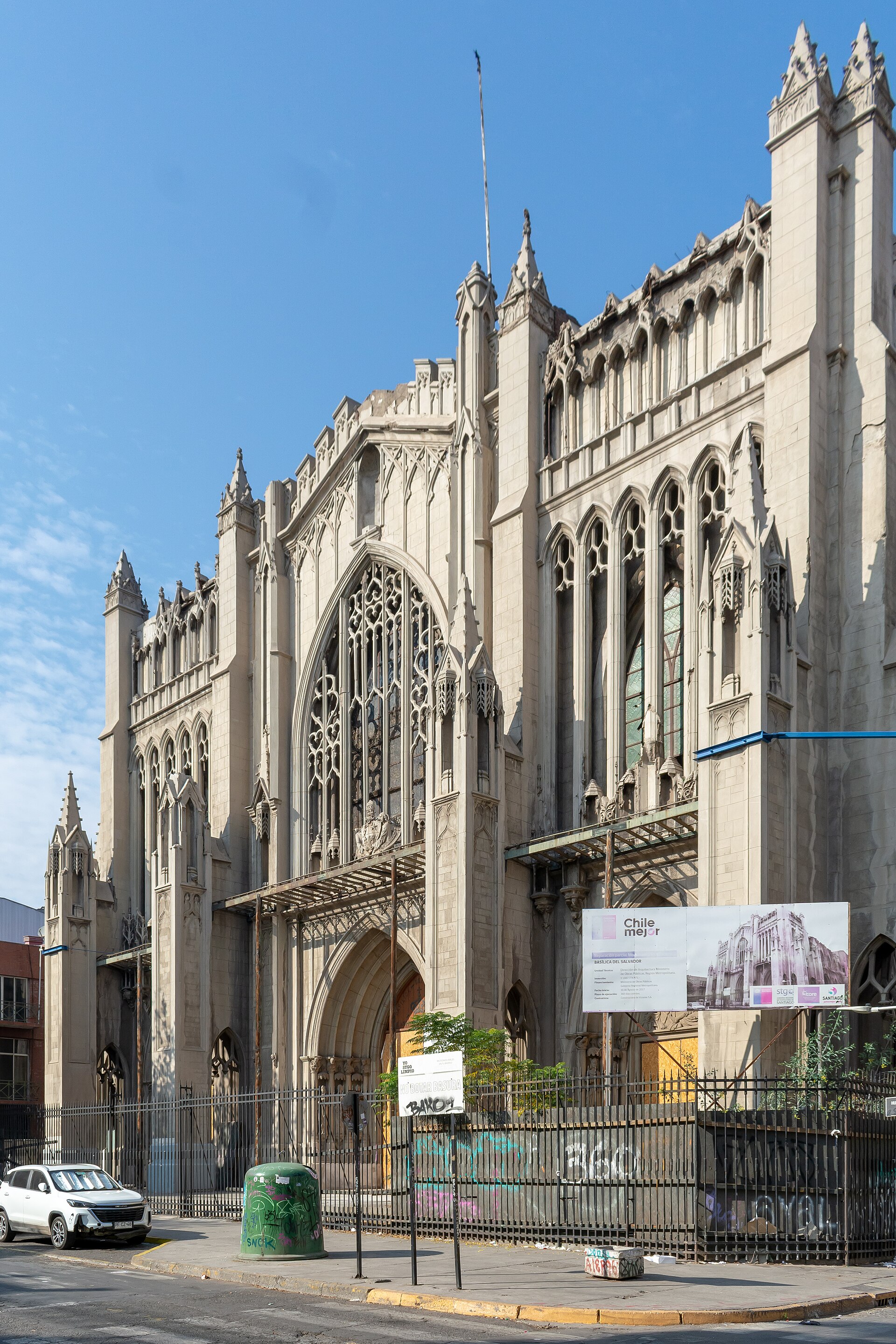
The Basílica del Salvador is one of those rare places in Santiago where the past lingers, untouched by the rush of modern life. Tucked away at the intersection of Huérfanos and Alameda, in the heart of the city’s historic center, it stands as a quiet witness to over a century of change. From the outside, its neoclassical façade—with its columns and arches—announces itself boldly, a nod to the European influences that shaped its design. But step inside, and the atmosphere shifts. Here, time moves differently.
Construction of the basilica began in 1873 and stretched over nearly two decades, finally completing in 1892. The architect, Teodoro Burchard, drew inspiration from Italian cathedrals, and the building’s proportions and details reflect that vision. Yet Chile had its own plans for the structure. Earthquakes, a recurring force in the country’s history, repeatedly altered its form. The most devastating quake in 1985 left the basilica severely damaged, forcing it to close for years. Even now, restoration continues in stages, with parts of the interior open to visitors.
The main nave is a study in contrasts—grand yet intimate, ornate yet weathered. Frescoes and intricate plasterwork adorn the walls, while the marble and gilded bronze altar commands attention at the center. Stained-glass windows, imported from Europe, filter light in soft hues, casting a glow that feels almost sacred. The basilica was never fully restored to its original splendor, but that only adds to its character. The scars of time are visible, yet the space retains a sense of reverence.
In its early years, the basilica was more than just a place of worship. It was a focal point of colonial Santiago, where markets bustled, processions marched, and communities gathered. The surrounding neighborhood has since transformed, with modern buildings and busy streets encircling the church. Yet the basilica remains, a steadfast presence amid the flux.
What makes this building particularly fascinating is its resilience. Built from brick and stone, its construction was unusual for 19th-century Chile. After earthquakes, engineers studied its structure to understand how it withstood the tremors. Some of those insights later influenced the design of other churches in the region. The basilica’s ability to endure speaks to both the skill of its builders and the unpredictable nature of the land it stands on.
Visitors here are few, which only enhances the experience. There’s time to wander, to notice the small details—the way the light catches the gilding, the texture of the aged walls, the faint echoes of footsteps on the stone floors. Occasionally, the sound of an organ fills the space, and for a moment, the basilica feels alive again, as if the past and present have briefly merged.
The Basílica del Salvador isn’t just a relic of history; it’s a living piece of Santiago’s story. It doesn’t demand attention like the grander landmarks of the city, but those who seek it out find something far more meaningful—a place where the weight of time is palpable, and the quiet beauty of endurance is on full display. If you find yourself in Santiago, it’s worth stepping inside, if only to pause and listen to the echoes of a city that has grown up around it.