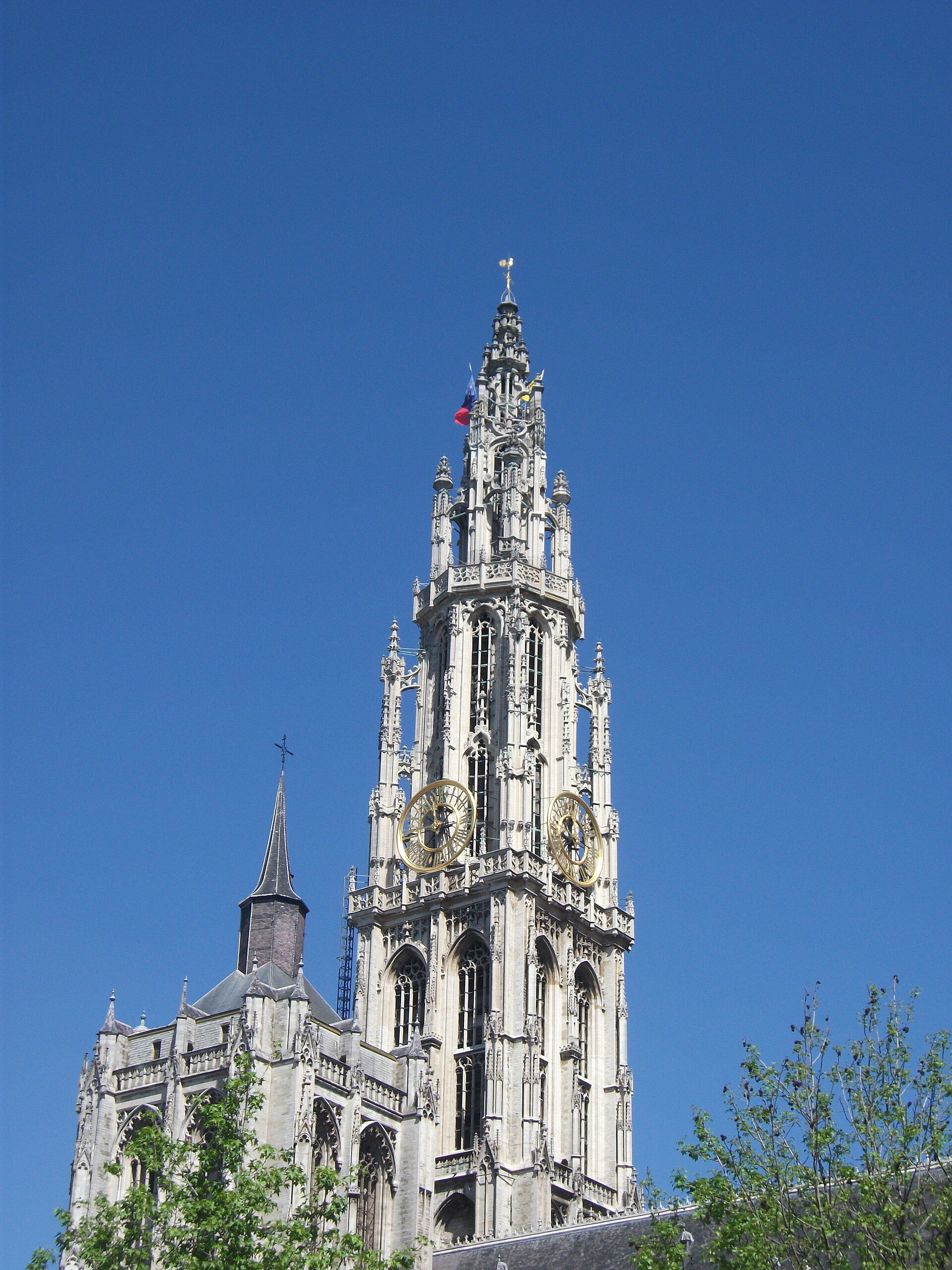
Antwerp’s Cathedral of Our Lady stands at the heart of the city, a towering presence that has shaped its skyline for centuries. Built over nearly two hundred years, from the late 14th to the early 16th century, it remains one of the most ambitious Gothic projects in Northern Europe. The cathedral’s single spire, the tallest church tower in the Low Countries, was meant to be paired with a second, but that ambition was never realized. Even unfinished, it dominates the cityscape, a silent witness to Antwerp’s rise as a medieval powerhouse of trade and art.
Inside, the vast nave unfolds with a sense of quiet grandeur. The soaring columns and ribbed vaults draw the eye upward, while the soft light filtering through stained glass softens the stone’s severity. The cathedral houses several masterpieces, including works by Peter Paul Rubens, Antwerp’s most celebrated painter. His *Descent from the Cross* and *The Elevation of the Cross* hang in side chapels, their dramatic compositions and rich colors a counterpoint to the Gothic architecture. These paintings were created for the cathedral itself, and their presence here feels intentional, as if the space was designed with them in mind.
The cathedral’s history is as layered as its architecture. It was built on the site of an earlier Romanesque church, which in turn may have stood where a Carolingian chapel once was. Over the centuries, it has weathered fires, iconoclasm, and neglect. During the Reformation, Protestant mobs stripped it of its decorations, and later, under French occupation, it was repurposed as a warehouse. Yet it endured, restored in the 19th century to something resembling its former glory. The scars of these upheavals are still visible in places—the worn steps, the patched stonework—hinting at the passage of time.
Beyond its artistic and architectural significance, the cathedral has long been a place of pilgrimage and reflection for the city’s inhabitants. It has witnessed coronations, royal weddings, and funerals, serving as a backdrop to Antwerp’s most pivotal moments. Even today, it remains an active parish church, with daily masses and a steady stream of visitors. The sound of the organ, one of the largest in Belgium, fills the space during services, its deep tones resonating through the nave.
The square outside the cathedral is a natural gathering place, where the city’s rhythm slows for a moment. Cafés spill onto the cobblestones, and street musicians often play near the entrance. From here, the cathedral’s spire seems even more imposing, its intricate details softened by distance. It’s a reminder of how deeply the building is woven into Antwerp’s identity—a symbol of both faith and resilience, standing firm through centuries of change.
For those who take the time to explore beyond the main nave, the cathedral reveals smaller, more intimate spaces. The ambulatory, with its chapels radiating from the apse, offers a quieter experience. Some of these chapels contain lesser-known artworks, while others are simple and unadorned, their plainness a contrast to the opulence elsewhere. The treasury, though modest in size, holds relics and liturgical objects that speak to the cathedral’s long history of devotion.
The cathedral’s role in Antwerp’s cultural life extends beyond religion. It has inspired writers, artists, and musicians, from the Flemish primitives to contemporary creators. The building itself has been a muse, its proportions and light studied by architects and painters alike. Even those who visit without a particular interest in history or art often find themselves moved by the atmosphere—the way the light shifts throughout the day, the echoes of footsteps on stone, the sense of continuity with the past.
In a city known for its mercantile spirit, the Cathedral of Our Lady offers a different perspective. It’s a place where the pace slows, where the noise of the modern world fades into the background. Whether you come for the art, the architecture, or simply to sit in silence, it leaves an impression that lingers long after you’ve stepped back into the bustling streets of Antwerp.