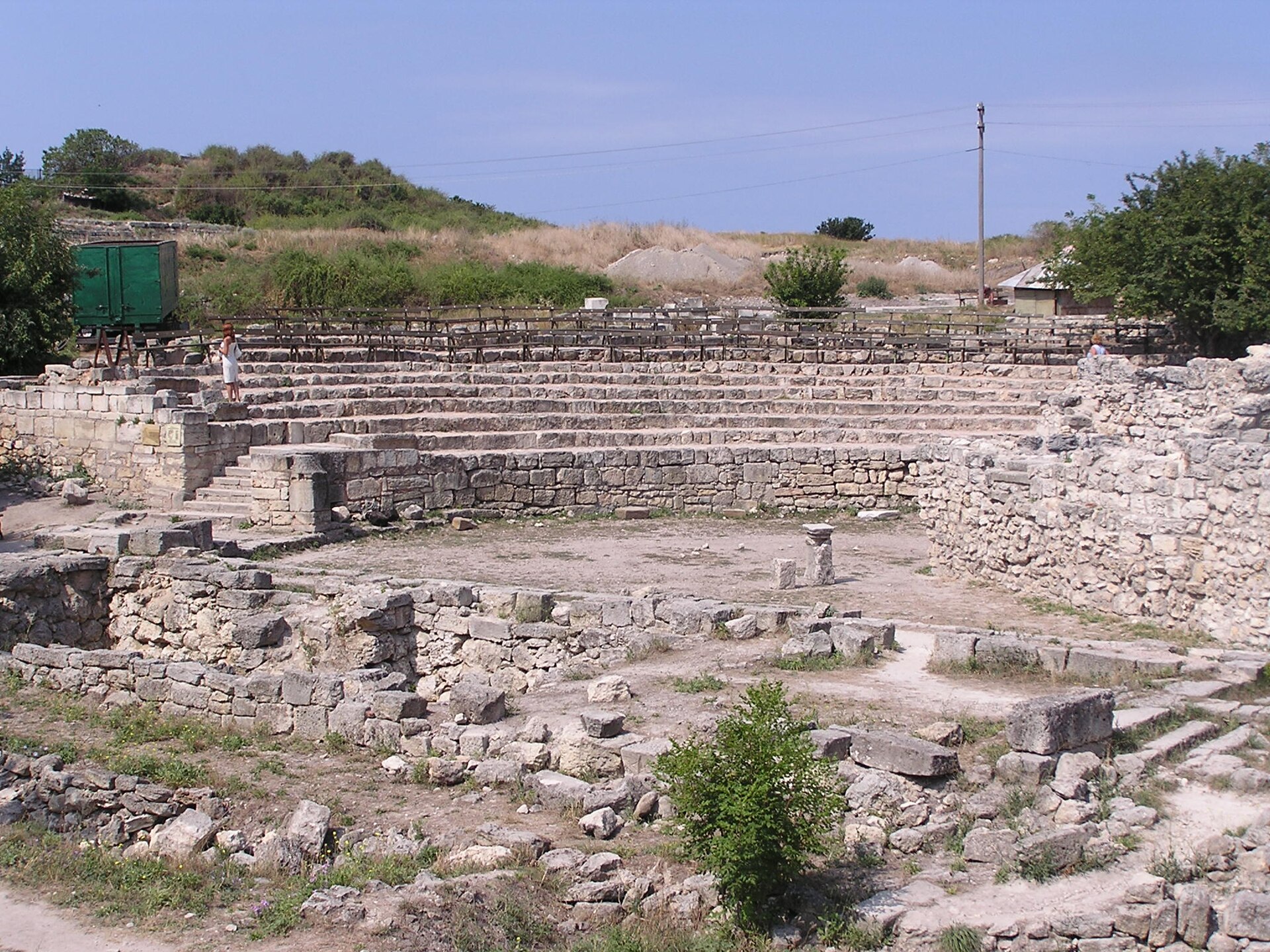
The ancient theater at Chersonesus is one of those rare places where time seems to stand still, leaving behind only stone and silence. Nestled within the ruins of the once-great city of Tauric Chersonesus, it serves as a quiet reminder of an era when this was more than just a Greek colony—it was a thriving cultural and political hub of the northern Black Sea region. Built in the 3rd century BCE, when Chersonesus was already flourishing as a center of trade and craftsmanship, the theater connected the classical world with the tribes of the northern shores. Today, its remains lie exposed to the elements, each weathered stone holding echoes of performances that once drew thousands beneath its arches.
Unlike many Greek theaters carved into hillsides, this one was hewn directly from the rocky terrain, a practical adaptation to the local landscape. The semicircular tiers of seating descend toward the orchestra, the circular stage where actors and chorus once performed. At its center, a small altar dedicated to Dionysus, the god of wine and theater, hints at the sacred role this place played in ancient life. With a capacity of around two thousand spectators, the theater’s scale reflects Chersonesus’s importance—not just as a provincial outpost, but as a significant cultural center in its own right.
Over the centuries, the theater evolved alongside the city. When Chersonesus fell under Roman influence, the structure was repurposed to suit the tastes of its new rulers. Gladiatorial combats and other spectacles replaced Greek tragedies, and underground chambers were added to house animals and fighters. Yet, as the Roman Empire waned, so did the theater. Its stones were scavenged for new construction, and the site faded into obscurity, buried beneath grass and time.
Now part of the Chersonesus Taurica museum-reserve, the theater is more than an archaeological site—it’s a place where visitors can walk the same steps as ancient audiences who once gathered to watch the works of Sophocles or Aristophanes. In the summer months, small reenactments of classical performances occasionally bring the space to life, if only for a moment. The sound of a lyre or the murmur of actors’ voices drifts through the air, briefly bridging the gap between past and present.
What makes this theater particularly compelling is its layered history. It outlasted the Greeks, Romans, Byzantines, and Genoese, each civilization leaving its mark. In the Middle Ages, Christian churches rose among its ruins, and later, Ottoman fortifications stood where the stage once did. Each era took something away or added something new, yet the theater endured, a silent witness to the passage of time.
For Sevastopol, Chersonesus is more than just a tourist attraction—it’s a cornerstone of the city’s identity. Here, on the outskirts of a modern metropolis, the roots of European culture are tangible, brought to these shores by Greek settlers over two millennia ago. The theater is just one piece of that legacy, but perhaps the most evocative. It serves as a reminder that history isn’t always written in books; sometimes, it’s carved into stone.
Visiting Chersonesus is an experience that engages more than just the eyes. The sea breeze, the crash of waves, the scent of wormwood and salt—all of it weaves together to create an atmosphere that lingers long after you leave. The theater isn’t just a photo opportunity; it’s a place to pause, to sit on a weathered stone bench, and to imagine the voices that once filled this space with poetry and myth.
Of course, only ruins remain today, but even those are striking. The surviving steps, fragments of walls, and the orchestra’s outline allow the mind to reconstruct what once was. If you’re lucky enough to visit on a quiet evening, when the crowds have thinned and the sun dips below the horizon, you might sense how alive this place still feels. It doesn’t demand grand descriptions or dramatic storytelling—it simply exists, and that’s enough.