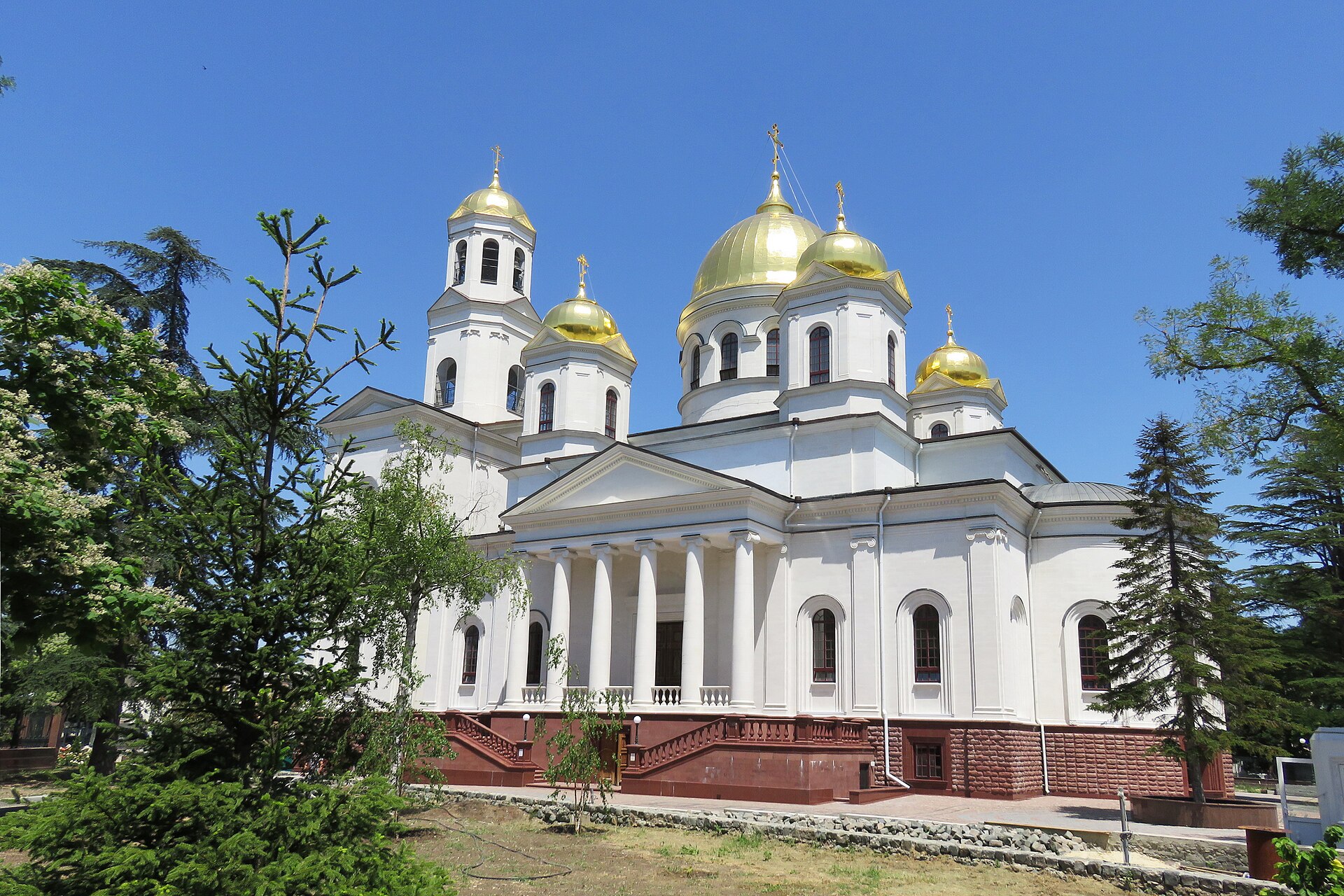
Standing at the heart of Simferopol, the Alexander Nevsky Cathedral is one of those rare places where time seems to pause, allowing the layers of history to breathe. Built in the mid-19th century, it was never just a church—it became a symbol of the city itself, a quiet witness to its transformations. Named after Prince Alexander Nevsky, the medieval Russian leader whose legacy is tied to the defense of the nation, the cathedral carries a weight that goes beyond its religious purpose. It’s a monument to resilience, a place where faith and history intertwine.
The architecture of the cathedral reflects the Russian-Byzantine style that was popular in the 19th century, blending grandeur with a sense of harmony. The central dome rises high above the city, flanked by four smaller ones, creating a silhouette that’s both imposing and graceful. The facades are adorned with arches and columns, their details intricate yet understated, giving the building a timeless elegance. Inside, the space feels vast yet intimate, with golden iconostases, intricate frescoes, and the soft glow of candlelight guiding visitors through its sacred corners.
The cathedral’s history is as much a part of Simferopol as the streets that surround it. Construction began in 1868, driven by locals and clergy who wanted to honor the end of the Crimean War. But building a cathedral takes time, and it wasn’t until 1891 that the structure was finally consecrated. By then, the city had already seen its share of upheavals, and the cathedral stood through them all. In the Soviet era, like many religious sites, it was repurposed—first as a warehouse, then as a planetarium. It wasn’t until the 1990s that the cathedral was returned to the faithful, and since then, it has slowly reclaimed its role as a spiritual center.
Today, the Alexander Nevsky Cathedral is a living place of worship. Services, baptisms, and weddings are held here regularly, and the air is often filled with the sound of hymns and the scent of incense. On major Orthodox holidays, the cathedral comes alive in a way that feels almost tangible—the flicker of candles, the murmur of prayers, the deep resonance of the choir. Even on ordinary days, there’s a sense of stillness here, a rare quiet in the middle of a bustling city.
The cathedral sits on a slight elevation in the center of Simferopol, its domes visible from a distance, almost like a beacon. It’s easy to find, standing at the intersection of the city’s main streets, surrounded by a small park where locals often gather. The park is a place to pause, to sit on a bench and take in the view, or simply to escape the noise of the city for a while. Tourists stop here too, some to take photos, others to light a candle inside. There’s no rush, no pressure—just the slow rhythm of a place that has seen generations come and go.
What makes the cathedral special is that it doesn’t feel like a relic. It’s not a museum piece, frozen in time. Instead, it’s a part of daily life for many in Simferopol. Some were baptized here, others married within its walls. Even those who don’t consider themselves religious often find themselves drawn to its quiet beauty. The cathedral has a way of making history feel personal, as if the stories of those who came before are still lingering in the air.
Over the years, the cathedral has undergone careful restoration to preserve its original character. The work is done with precision, ensuring that every detail—from the frescoes to the decorative elements—remains true to its time. The result is a building that looks well cared for but not overly polished, retaining the patina of age that gives it depth. It’s a balance between preservation and life, between the past and the present.
For many, the Alexander Nevsky Cathedral is more than just a landmark. It’s a place where the past and present coexist, where the weight of history feels tangible yet not overwhelming. In a world that moves too fast, it offers a moment of stillness, a chance to reflect. Whether you come for prayer, for history, or simply for the quiet, the cathedral has a way of making you feel connected—to the city, to its people, and to something larger than yourself.