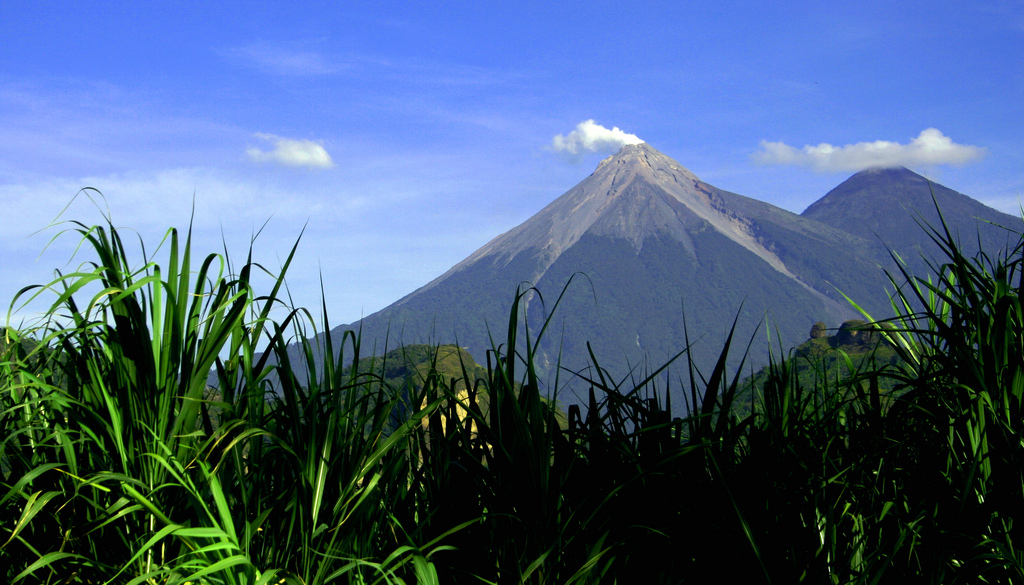
Acatenango stands apart from the other peaks that rise above the valleys of Antigua Guatemala. Its twin summits, joined by a gentle saddle, create a silhouette instantly recognizable to anyone who has spent time in the region. The volcano looms quietly, its slopes draped in forests and coffee plantations, but its presence is impossible to ignore. Though it hasn’t erupted in decades, the occasional wisp of smoke from its crater serves as a reminder that beneath the stillness, something ancient and powerful still stirs.
The climb up Acatenango is less a hike than a slow, deliberate journey into another world. The trail begins in small villages at the mountain’s base, where local guides wait to lead travelers through the shifting landscapes. First come the coffee fields, their neat rows giving way to dense forests that muffle all sound except the rustle of leaves and the distant call of birds. Higher up, the trees thin out, replaced by rocky slopes and patches of alpine grass where the air grows thin and every step requires more effort. By the time you reach the base camp, the world below feels distant, almost unreal. But the real reward comes at night, when the neighboring volcano, Fuego, lights up the darkness with bursts of glowing lava. The sight is mesmerizing—flashes of fire against the black sky, a reminder of the earth’s raw, untamed energy.
For centuries, Acatenango has been more than just a mountain to the people who live in its shadow. The indigenous Maya communities of the region have long regarded it as a sacred place, where the spirits of ancestors reside. Even today, some locals leave offerings at its base, seeking protection or good fortune. When the Spanish arrived and founded Antigua Guatemala, they too understood the volcano’s significance. They built their colonial city with an eye toward the peaks, knowing that the rich volcanic soil made the land fertile but also that the mountains could turn destructive in an instant. History here is written in layers of ash and resilience—people have fled eruptions only to return, drawn back by the land’s generosity.
The villages that cling to Acatenango’s slopes reflect this uneasy relationship with the natural world. Houses are built low to the ground, their thick stone walls and small windows designed to withstand the wind and occasional showers of ash. Churches and chapels dot the landscape, their facades often adorned with images of volcanoes, as if to acknowledge that human life here is temporary. Even in Antigua Guatemala, with its cobbled streets and pastel-colored buildings, the volcano remains a constant presence. The city seems to exist in its shadow, aware that the mountain could one day remind everyone of its power.
For those who make the ascent, Acatenango offers something rare—a chance to step outside the noise of modern life. There are no crowds, no souvenir stands, no scripted experiences. Just the trail, the wind, and the occasional rustle of wildlife in the underbrush. Camping at the base, around 3,500 meters up, is an experience in itself. The temperature drops sharply after dark, and the cold seeps through even the warmest sleeping bag. But the discomfort fades when Fuego erupts in the distance, its deep rumbles echoing through the night. By morning, the effort feels worthwhile as the sun rises over the clouds, painting the peaks in soft gold and pink.
Acatenango has a way of slowing time down. There’s no rush here, no urgency—just the steady rhythm of the climb and the quiet vastness of the landscape. Even those who never set foot on its slopes can feel its presence from Antigua Guatemala’s cafes and plazas. At sunset, the volcano’s silhouette glows against the sky, almost as if it’s breathing in sync with the city below. For locals, it’s a symbol of endurance; for visitors, a humbling reminder of nature’s scale. What makes Acatenango special isn’t just its beauty or its challenges, but the way it forces you to see the world differently—bigger, older, and far more mysterious than it seems at first glance.