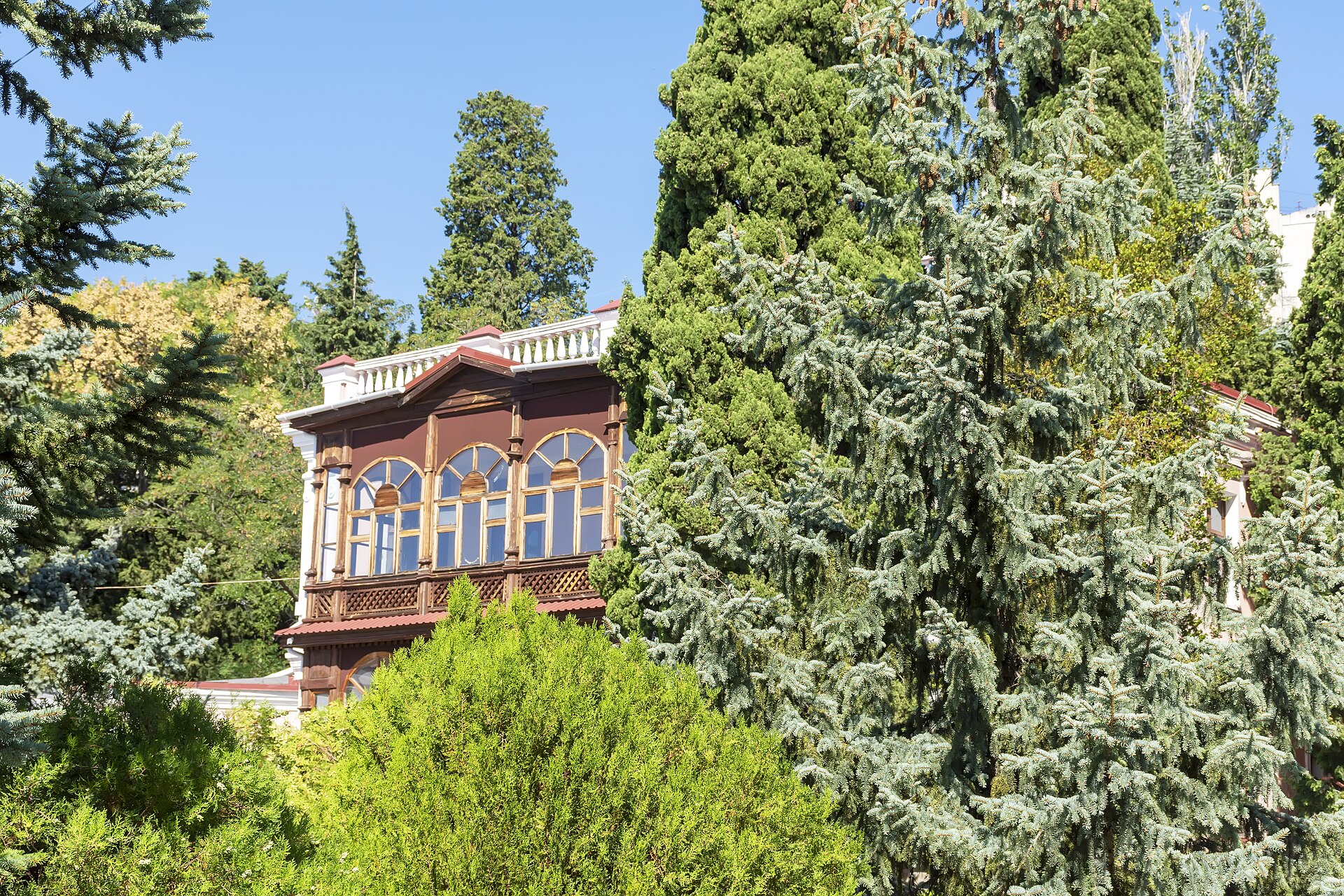
Perched on a dramatic cliffside between Yalta and Alupka, the Ai-Todor estate feels like a place where history hasn’t just settled—it lingers in the salt air and the rustle of old trees. This was once the summer retreat of Grand Duke Alexander Mikhailovich, a grandson of Nicholas I, where Russian aristocracy gathered in the late 19th century. The estate’s faded grandeur still whispers of an era when emperors and artists sought refuge here, drawn by the wild beauty of the Crimean coast.
The centerpiece of Ai-Todor is the palace designed by Nikolai Krasnov, the same architect behind the nearby Livadia Palace. His work here blends solidity with intimacy—tall windows frame sweeping sea views, while balconies and terraces cascade toward the water like natural extensions of the cliff. The architecture resists a single style, borrowing from medieval romanticism while adapting to the practical needs of a seaside estate. The result is a building that feels both grand and lived-in, as if it grew from the rock rather than being imposed upon it.
The surrounding park was once a showcase of exotic plants, carefully curated by the grand duke, who had a passion for botany. Today, the grounds are a mix of cultivated and wild, where towering magnolias and weathered pines stand alongside overgrown paths and crumbling stonework. The neglect isn’t an eyesore; it softens the edges of the past, making the estate feel more like a relic than a museum. In spring and autumn, when the crowds thin, the park belongs to the wind and the waves, and the old benches and broken fountains take on a quiet dignity.
At the tip of the cape stands the Ai-Todor lighthouse, a modest but enduring presence. Built in the mid-19th century, its red-and-white stripes still guide ships through the Black Sea’s unpredictable waters. From the small platform beside it, the view stretches to the horizon, where the sea meets the sky in a blur of blue. On stormy days, the waves crash against the cliffs with such force that spray reaches the lighthouse, a reminder of nature’s raw power. It’s a place where time feels suspended, where the only sounds are the wind and the distant cry of gulls.
The estate’s history mirrors the upheavals of the 20th century. After the revolution, the palace was repurposed as a tuberculosis sanatorium, then a wartime hospital, and later a Soviet-era rest home. Decades of neglect followed, and while restoration efforts have begun in recent years, much of Ai-Todor remains untouched. Some rooms have been returned to their former elegance, but the estate is far from polished. It’s a place that invites contemplation rather than admiration, where the scars of time are part of its charm.
There’s a persistent local legend that Anton Chekhov visited Ai-Todor, drawn by the grand duke’s hospitality and the dramatic coastal scenery. While no definitive proof exists, the idea isn’t far-fetched—Chekhov spent years in Crimea, and the estate’s atmosphere aligns with the settings of his stories. Whether or not he ever sat on the palace terrace with a notebook, the possibility adds a layer of literary mystique to the place. Occasionally, the estate hosts small concerts or readings, but more often, it’s simply quiet, the silence broken only by the rhythm of the waves.
Ai-Todor isn’t a destination for those seeking bustling attractions or modern comforts. There are no souvenir stalls, no crowded cafés, no guided tours with scripted anecdotes. Instead, it offers something rarer: a sense of continuity with the past. Walking the overgrown paths, you can almost hear the echoes of long-ago conversations, the clink of tea cups on the terrace, the laughter of guests who once gathered here. The estate’s incompleteness is part of its appeal—it hasn’t been sanitized for tourists, and its imperfections make it feel authentic.
The best time to visit is in the off-season, when the light is soft and the air carries the scent of pine and salt. The palace and lighthouse are still there, but the real draw is the landscape itself—the way the cliffs drop into the sea, the way the wind carries the sound of the waves, the way the past and present blur at the edge of the continent. Ai-Todor isn’t just a place to see; it’s a place to feel, where the weight of history settles gently on your shoulders.