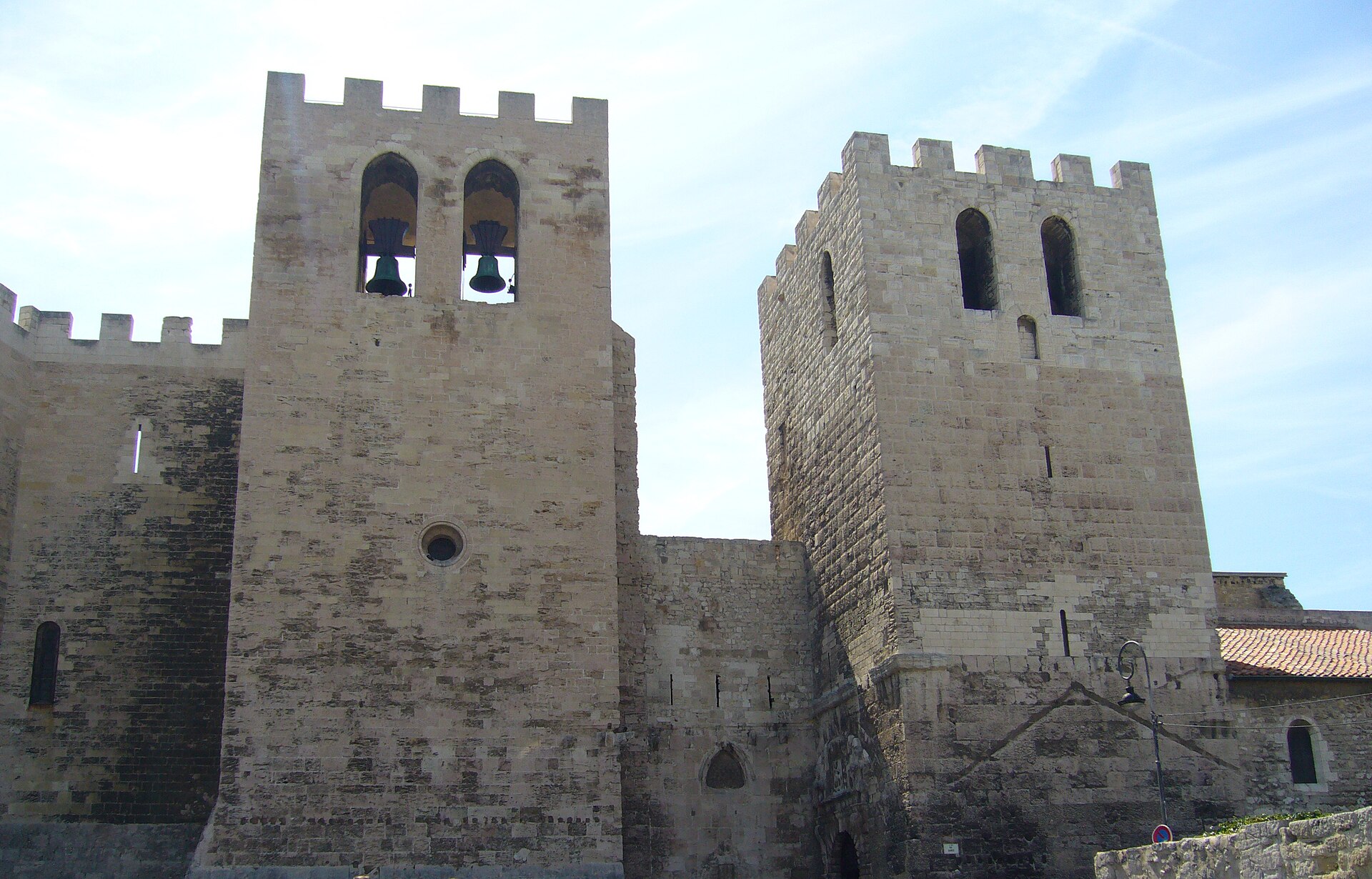
Saint-Victor Abbey in Marseille is one of those rare places where history isn’t just preserved in stone—it lingers in the air, woven into the fabric of the city itself. Founded in the 5th century, the abbey has stood on the edge of the Mediterranean for over fifteen hundred years, bearing silent witness to the rise and fall of empires, the ebb and flow of faith, and the transformation of a small port town into a bustling metropolis. Unlike remote monasteries tucked away in mountain valleys, Saint-Victor has always been part of Marseille’s daily life, a spiritual anchor in a city shaped by trade, migration, and the restless energy of the sea.
The architecture of the abbey is a physical record of time, each layer revealing a different era. The oldest part, the crypts, dates back to late antiquity, their low vaults and rough-hewn stone blocks evoking the secrecy of early Christian worship. Here, in the dim light, you can still see sarcophagi from the 4th and 5th centuries, their surfaces carved with biblical scenes—a rare glimpse into the art of a time when Christianity was still finding its voice. Above ground, the Romanesque basilica, built in the 12th century, rises with a fortress-like solidity. Its thick walls and narrow windows weren’t just for aesthetics; in an age of raids and sieges, the abbey had to defend itself, and its design reflects that need for protection.
For centuries, Saint-Victor was far more than a place of prayer. In the Middle Ages, it was a powerhouse in Provence, a center of pilgrimage where the relics of saints drew the faithful from across the region. The abbots wielded influence beyond the monastery’s walls, mediating political disputes and managing vast estates. The abbey even minted its own coins, a sign of its economic clout. By the 13th century, it had become an intellectual hub, with scribes copying manuscripts and a library that rivaled the great collections of southern France. Though its political and cultural dominance waned during the Renaissance, it remained a spiritual landmark for Marseille, a quiet but enduring presence in the city’s collective memory.
Today, the abbey feels like a hidden corner of the past in the heart of a modern city. Visitors wander through the crypts, tracing their fingers over ancient stone, or sit in the courtyard, where the scent of lavender mingles with the salt air. The basilica still holds services, and if you’re lucky, you might hear the echo of Gregorian chant drifting beneath the high ceilings. Every February, the abbey comes alive during Candlemas, an old tradition where worshippers bring candles to the church and bonfires light up the streets of Marseille. For a brief moment, the abbey reclaims its role as the city’s spiritual center, just as it has for centuries.
The streets around Saint-Victor carry the same sense of layered history. The narrow lanes leading to the abbey from the Old Port feel like a remnant of medieval Marseille, with their crumbling facades and small shops selling everything from spices to handmade soap. The harbor itself is just steps away, where fishing boats and yachts bob in the water, and the lively Le Panier district begins, with its cafés and bars spilling onto the sidewalks. The contrast between the abbey’s quiet dignity and the city’s vibrant chaos creates a strange, almost dreamlike atmosphere—one where time seems to slow down within the monastery’s walls and speed up the moment you step outside.
What makes Saint-Victor special is that it isn’t a museum. There are no glass cases or roped-off exhibits, just stone that has absorbed the footsteps of generations. You can touch the same walls that once sheltered early Christians, merchants, and pilgrims, or stand in the courtyard where monks once walked in silent procession. The abbey doesn’t demand attention; it simply exists, a quiet witness to the passage of time. It’s a place where the past isn’t distant or abstract—it’s right there, in the cool shade of the crypts, in the salt-tinged breeze, in the way the light filters through the narrow windows.
Marseille has always been a city of crossroads, a gateway between Europe and the Mediterranean, and Saint-Victor embodies that duality. It’s a place where the sacred and the secular have coexisted for centuries, where the rhythms of prayer and commerce intertwine. The abbey doesn’t try to impress; it doesn’t need to. Its power lies in its authenticity, in the way it has endured without fanfare, adapting to each new era while holding onto its essence. Whether you come for the history, the architecture, or just a moment of quiet in a busy city, Saint-Victor offers something rare: a connection to the past that feels alive, immediate, and deeply human.