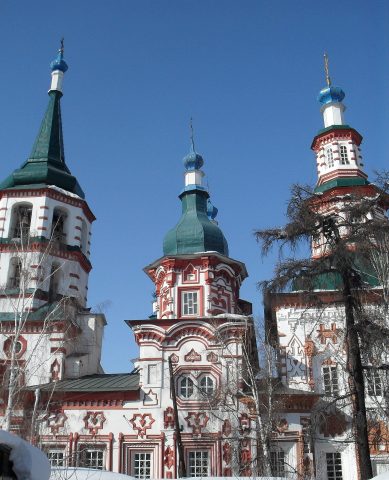
Irkutsk’s 130th Quarter is a pocket of the past tucked beneath the spires of the Krestovozdvizhenskaya Church, a place where the city’s wooden heritage has been carefully pieced back together. Reconstructed for Irkutsk’s 350th anniversary in 2011, this neighborhood brings together over sixty historic wooden houses, some restored where they stood, others relocated from across the city. The result isn’t a museum exhibit but a living street, where the creak of old floorboards and the scent of aged timber blend with the hum of modern life.
The houses here date back to the 19th and early 20th centuries, their facades adorned with intricate carvings—delicate lacework of window frames, gates, and eaves that speak to the craftsmanship of a bygone era. Inside, the buildings now host restaurants, small shops, guesthouses, and museums, their interiors repurposed but still carrying the warmth of their original purpose. It’s a rare balance: the past isn’t frozen in time but woven into the present, offering a glimpse of how Irkutsk once looked and felt.
At the entrance, a bronze statue of the *babr*—Irkutsk’s mythical heraldic beast—stands guard. The creature, a mix of tiger and sable, was born from a historical misinterpretation: an early description mistakenly turned it into something between a feline and a beaver, complete with webbed paws and a broad tail. Locals rub its paw for luck, and over the years, the metal has been polished smooth by countless hands.
Irkutsk has long been known for its wooden architecture, a legacy of Siberia’s forests and the skill of its builders. While other parts of the city still hold fragments of this heritage, the 130th Quarter offers the most accessible way to experience it. Elsewhere, historic houses stand in varying states of repair, some lovingly preserved, others slowly fading. Here, the past has been given a second life, not as a relic but as a place where people still gather, eat, and wander.
By evening, the quarter transforms. Soft lights glow from the windows of cafes and restaurants, and the wooden walkways take on a golden hue. It’s a favorite spot for an after-dinner stroll, the air filled with the murmur of conversations and the occasional clink of glasses from the outdoor terraces. The atmosphere is relaxed, almost village-like, a contrast to the bustle of the city just beyond its borders.
From here, the Angara River’s embankment is just a short walk away, its waters reflecting the lights of the city. Nearby, the imposing statue of Alexander III stands as a reminder of Irkutsk’s imperial past, while the Decembrists’ Museum in the Volkonsky House offers a quieter, more intimate look at the city’s role in Russia’s turbulent 19th century. The quarter serves as a natural starting point for exploring these landmarks, a place to pause before diving deeper into Irkutsk’s history.
There’s no admission fee, and the entire area is pedestrian-friendly, with no cars to disrupt the rhythm of a leisurely walk. From the train station, it’s a fifteen-minute ride by bus or tram, a straightforward journey that drops you right at the heart of the quarter. Parking is available near the entrance, though on weekends, spaces fill up quickly. Two pedestrian paths lead down into the neighborhood, offering different perspectives on the wooden houses and the life unfolding between them.
The quarter isn’t just a summer destination. In winter, ice sculptures and small sledding hills appear, turning the space into a festive scene. The wooden houses, dusted with snow, take on a fairy-tale quality, their carved details softened by the cold. Even the *babr* seems to wear a frosty coat, its bronze surface gleaming under the pale winter sun.
Year-round, the quarter’s small cinema and planetarium offer a break from the outdoors, their programs ranging from local films to stargazing sessions. It’s one of those places where the line between past and present blurs, where a 19th-century house might host a modern café, and where the stories of the city’s founders feel just a little closer. Whether you come for the architecture, the food, or simply the chance to wander, the 130th Quarter is a reminder of how history can be both preserved and lived in.