Matera
Italy · 6 places
Photo: Wikimedia Commons, CC BY-SA 3.0
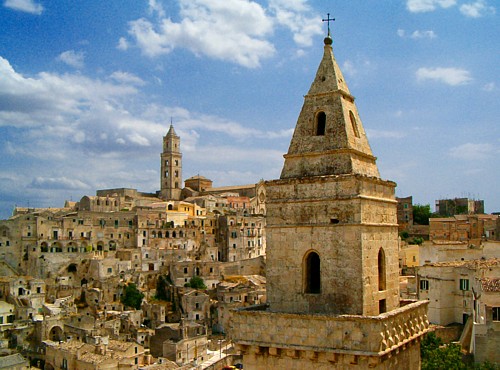
Matera feels like a place where time has paused, not to preserve it under glass, but to let it breathe. Perched on the edge of a deep ravine, the city unfolds slowly, its stone houses carved directly into the rock, their facades blending seamlessly with the cliffs. The streets are narrow, winding paths that twist and turn, leading you deeper into the *sassi*—the ancient cave districts that have sheltered people for millennia. There’s no rush here, no modern clamor, just the quiet persistence of a city that has watched centuries pass without losing its soul.
The heart of old Matera is split between two neighborhoods: Sasso Barisano and Sasso Caveoso. Separated by a steep gorge, they’re connected by bridges and staircases, forming a maze that’s easy to lose yourself in but impossible to resist. The houses weren’t built so much as coaxed from the soft tufa rock, their rooms hollowed out of natural caves. Some are still homes, others have become boutique hotels, restaurants, or tiny museums where you can step into the past—literally. In Sasso Caveoso, medieval churches with faded frescoes stand as silent witnesses to the city’s layered history, their walls telling stories of faith and daily life from centuries ago.
For much of the 20th century, Matera was a place Italy tried to forget. The *sassi* were seen as a national shame, overcrowded slums where families lived in cramped, windowless caves without running water or electricity. It wasn’t until the government relocated residents to modern housing in the 1950s and restoration began that the world took notice. Now a UNESCO World Heritage site, Matera hasn’t become a sterile open-air museum. Life still hums here—markets buzz, artisans work in their studios, and locals gather in piazzas. But when evening falls and the lights flicker on in the cave dwellings, the city transforms, its golden glow against the dark stone making it look like something out of a dream.
What Matera lacks in grand palaces or towering cathedrals, it makes up for in authenticity. Walking its streets is like flipping through the pages of a history book, each layer revealing something new: prehistoric settlements, medieval churches, abandoned caves repurposed as galleries. You can sip coffee in a café where the bread is baked the same way it was a hundred years ago, or buy pottery from a craftsman whose family has shaped clay here for generations. And if you climb to the viewpoint on the opposite side of the ravine, the reward is a panorama that justifies the journey—the city’s lights twinkling like stars, the houses merging with the rock as if they’ve always been part of the landscape.
Matera doesn’t shout about its beauty. It doesn’t need to. Unlike Rome or Florence, it isn’t overrun with tourists, and that’s part of its charm. Here, you can still glimpse Italy as it once was—unhurried, unpolished, living in quiet harmony with the land. The city has left its poverty behind, but it hasn’t lost the warmth that makes a place feel alive. There’s no grand spectacle, just the quiet magic of a city that has endured, adapted, and somehow remained itself. And that’s what lingers long after you leave.
Eat & Drink
0 placesNothing in this category yet — the catalogue is still growing.
All placesPlaces on the map
Marker colour follows the categoryClimate and weather
Detailed weather: Matera- Average temperature
- 18 °C
- Precipitation per year
- 524 mm
- Sunshine hours per day
- 7 h
Average air temperature
°C
10
11
12
16
20
26
29
28
24
19
15
11
Jan
Feb
Mar
Apr
May
Jun
Jul
Aug
Sep
Oct
Nov
Dec


