Manaus
Brazil · 7 places
Photo: See above, CC BY-SA 3.0
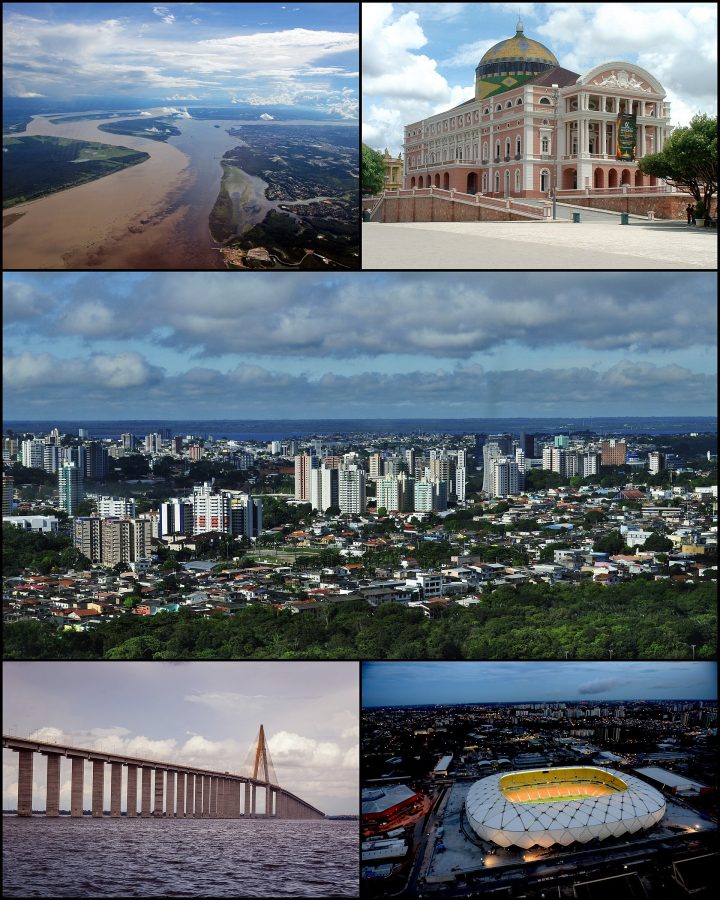
Manaos feels like a place plucked from the pages of an old adventure novel, a city where the Amazon’s wild heart beats strongest. It sits at the meeting point of the Rio Negro and the Solimões, where their waters swirl together to form the mighty Amazon itself. The jungle presses in at the edges, so close you half-expect the trees to creep into the streets overnight. Yet the city holds its ground, alive with the kind of energy that only a place this remote and vibrant can muster. As the capital of Amazonas, Brazil’s largest state, Manaos moves to its own rhythm—loud, colorful, and just a little unruly.
Its history is one of dramatic highs and sudden falls. Founded in the 18th century as a modest fort, it boomed into one of the world’s wealthiest cities during the rubber frenzy of the late 19th and early 20th centuries. For a time, fortunes were made overnight, and the city’s elite built marble palaces, imported grand pianos from Europe, and sailed to Paris on shopping sprees. The legacy of that era lingers in the Teatro Amazonas, an opera house crowned with a dome of 36,000 tiles in the colors of the Brazilian flag. Today, the theater still hosts performances, its red walls and gilded interiors a striking contrast to the jungle that surrounds it—a fragment of a vanished age, somehow preserved in the middle of nowhere.
But Manaos isn’t just a relic of the past. It’s a city that breathes in the present, even if its pulse is distinctly Amazonian. There’s no subway here; instead, motorbikes weave through the streets, and boats glide along the waterways that cut through the city. The Adolpho Lisboa Market, built in the early 1900s, remains the city’s beating heart. Under its iron roof, vendors sell everything from fruits you’ve never heard of to dried snakes and medicinal herbs brought in by Indigenous traders from the deep jungle. When the evening heat lifts, the Rio Negro waterfront comes alive—music spills from bars, fishermen grill their catch, and local kids launch themselves into the water from wooden docks, competing to see who can make the biggest splash.
What truly sets Manaos apart is its proximity to the wild. The jungle is just an hour away by boat, and many travelers come here for that very reason—to spot pink river dolphins, swim in the dark waters of the Rio Negro, or spend a night in an eco-lodge where the calls of howler monkeys echo through the trees after dark. But you don’t even need to leave the city to feel the Amazon’s presence. A walk through Mindu Park might reveal sloths dozing in the branches, while the botanical gardens offer a glimpse of the region’s staggering biodiversity. It’s a place where nature isn’t just scenery; it’s part of the city’s fabric.
Manaos doesn’t try to be like other Brazilian cities. There are no beaches like Copacabana, no samba rhythms like Rio, no colonial charm like Salvador. Instead, there’s the scent of damp earth and decaying leaves, the hum of boat engines, the squawks of parrots overhead. The city is a mix of cultures and languages, where Portuguese blends with Indigenous dialects. It’s not always an easy place for visitors—there’s no tourist-friendly polish here—but that’s exactly why it draws those looking for something real. Time moves differently in the jungle, and in Manaos, it’s easy to forget the outside world entirely.
Stay
0 placesNothing in this category yet — the catalogue is still growing.
All placesPlaces on the map
Marker colour follows the categoryClimate and weather
Detailed weather: Manaus- Average temperature
- 28 °C
- Precipitation per year
- 2380 mm
- Sunshine hours per day
- 5.4 h
Average air temperature
°C
28
28
28
28
28
28
28
29
30
30
29
28
Jan
Feb
Mar
Apr
May
Jun
Jul
Aug
Sep
Oct
Nov
Dec


