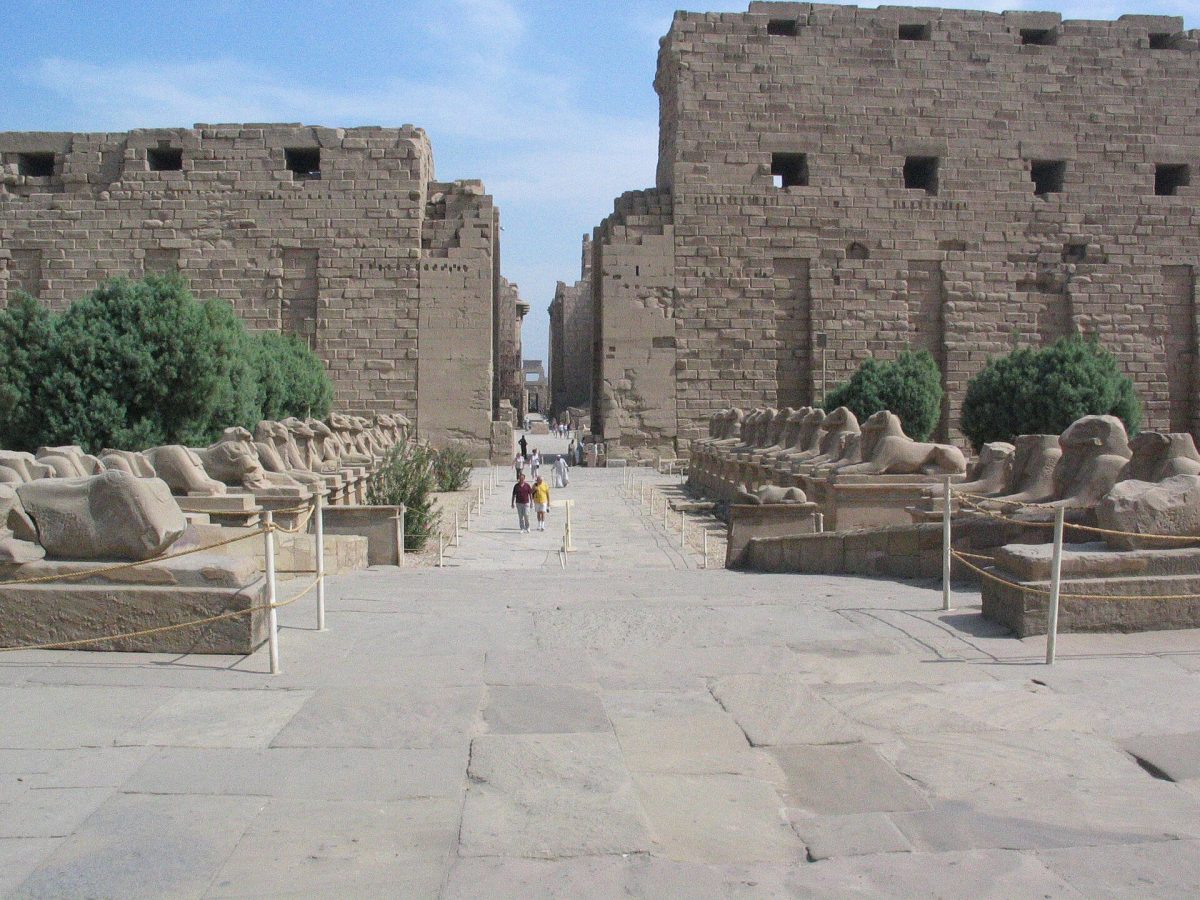
Karnak
Egypt · 6 places
Photo: Wikimedia Commons, Public domain
Karnak isn’t just a place on a map—it’s a vast, sunbaked stage where the past refuses to fade. Tucked along the Nile’s eastern bank, a short distance from Luxor, it was once the beating heart of Egypt’s spiritual life, a city of temples that grew layer by layer over nearly two thousand years. Here, the air carries the scent of dry earth and old stone, and the ground crunches underfoot with fragments of pottery left behind by generations long gone. The ruins rise from the dust like the bones of some colossal creature, their towering columns and weathered walls covered in hieroglyphs that still hum with stories. Time moves differently in Karnak. The shadows stretch long at dusk, and the silence between the stones feels heavier than the desert heat.
At the center of it all stands the Temple of Amun-Ra, a sprawling complex so vast it could swallow entire city blocks. Construction began in the Middle Kingdom and never truly stopped, with each pharaoh adding their own mark—new halls, obelisks, or sanctuaries—until the site became a patchwork of ambition and devotion. The Great Hypostyle Hall is its crown jewel, a forest of 134 columns soaring as high as a modern skyscraper. Walking beneath them, you can’t help but wonder about the hands that carved and raised them, the architects who dreamed of eternity, and the priests who once filled these halls with incense and chanting. When the sun dips low, the columns glow like embers, and the past feels almost tangible, as if the Nile’s slow current has carried the weight of centuries right up to your feet.
But Karnak was never just one temple. It was a constellation of sacred spaces, each dedicated to a different god—Mut, Montu, Ptah—each with its own rituals and secrets. The Sacred Lake, where priests once purified themselves, still reflects the sky like a mirror of polished stone. Smaller chapels and altars dot the complex, unassuming next to the grand colonnades but no less powerful. It’s in these quieter corners, where the light filters through cracks in the walls, that Karnak feels most alive. The air grows cooler, the noise of the modern world fades, and for a moment, you’re not a visitor but a witness to something older than memory.
Today, Karnak is a place where the past and present brush shoulders. Vendors sell cold drinks and trinkets near the entrance, their voices mingling with the cries of ibises circling overhead. Unlike the bustle of Luxor, the site has a quiet rhythm, broken only by the occasional call to prayer or the distant chug of a felucca on the river. As evening falls, floodlights bathe the ruins in a golden glow, and the walls seem to breathe again, whispering to anyone willing to listen. Karnak isn’t for those in a hurry. It’s for those who want to do more than see history—to stand in it, to feel the weight of the stones under their palms, and to understand that the true legacy of ancient Egypt isn’t in its gold or its pyramids, but in the way it still reaches across time, as real as the dust on your shoes.
Stay
0 placesNothing in this category yet — the catalogue is still growing.
All placesPlaces on the map
Marker colour follows the categoryClimate and weather
Detailed weather: Karnak- Average temperature
- 26 °C
- Precipitation per year
- 3 mm
Average air temperature
°C
15
17
22
27
32
34
35
35
32
28
22
17
Jan
Feb
Mar
Apr
May
Jun
Jul
Aug
Sep
Oct
Nov
Dec


