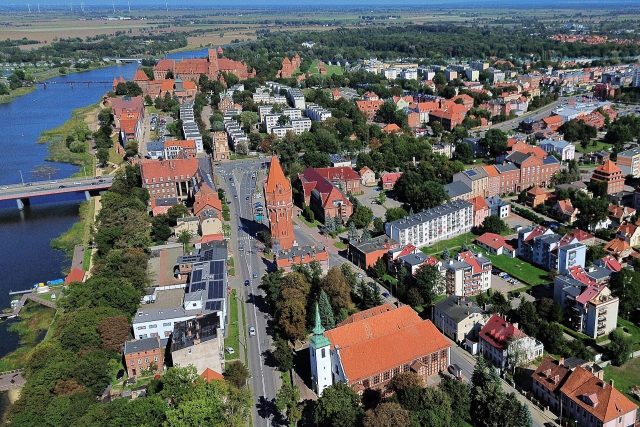
Yelabuga
Russia · 17 places
Photo: Vyacheslav Bukharov, CC BY-SA 4.0
Eлабуга feels like a place where time has settled into a slower rhythm, not frozen in the past, but simply content to exist as it always has. Perched on the high banks of the Kama River, where the water curves gently around the town, its streets cascade down toward the shore in terraces, following the natural contours of the land. There’s no rush here, no hum of a metropolis—just the quiet crunch of cobblestones underfoot and the occasional distant whistle of a passing riverboat. The town doesn’t try to be anything other than what it is, and that’s where its quiet charm lies.
Centuries of history are woven into the fabric of Елабуга, visible in every corner. It began as a trading post on the route from the Volga to Siberia, and the river has always been its lifeline. By the 19th century, the town had become a bustling hub for grain and timber trade, and the merchant mansions that still line its streets carry the echoes of that era. The most striking of these is the Spassky Cathedral, with its stark white walls and golden domes, standing sentinel on a hill as if watching over the town, a reminder of its former prosperity. Then there’s the house-museum of Ivan Shishkin, born here, whose paintings of Russian forests and fields have become icons of the country’s natural beauty. His story is a testament to how even a small town can leave a mark on the world.
Life in Елабуга moves at its own unhurried pace. There are no crowds of tourists racing from one sight to the next, just the freedom to wander its streets, peek into hidden courtyards, or sit by the riverbank watching the Kama flow by. In summer, the town comes alive with the scent of fresh berries and honey at the market, and music drifting through the parks. Winter, though, is when Елабуга grows even quieter, the snow blanketing the wooden houses until they look like something out of a fairy tale. It’s easy to imagine the town existing entirely on its own terms, untouched by the rush of the outside world.
Literature has left a deep imprint on Елабуга. Marina Tsvetaeva, one of Russia’s most beloved poets, was born here and spent her childhood in the town. Her house-museum is one of its most visited spots, and it’s not hard to see why—her writing was filled with tenderness and longing for this place, and even now, you can almost picture her walking these streets, breathing in the scent of the river and the grass. Then there’s the estate of Nadezhda Durova, the first woman to serve as an officer in the Russian army, whose life was as dramatic as any novel. These stories give the town a sense of depth, turning it from just another dot on the map into a place where history feels personal.
Елабуга doesn’t try to impress or overwhelm. It simply exists, with its unhurried pace, its old houses, and the river flowing by as it has for centuries. You could spend a day here or a week, and each time, you’d stumble upon something new—a forgotten shop selling samovars, a quiet square with a monument to an unknown poet, or just a secluded spot perfect for reading a book. The town doesn’t demand your attention, but it doesn’t let go easily either. It’s the kind of place you want to return to, like a well-loved book you keep coming back to.
Eat & Drink
0 placesNothing in this category yet — the catalogue is still growing.
All placesPlaces on the map
Marker colour follows the categoryClimate and weather
Detailed weather: Yelabuga- Average temperature
- 6 °C
- Precipitation per year
- 546 mm
Average air temperature
°C
-10
-8
-3
8
13
19
21
21
13
5
-2
-9
Jan
Feb
Mar
Apr
May
Jun
Jul
Aug
Sep
Oct
Nov
Dec