
Georgetown
Guyana · 8 places
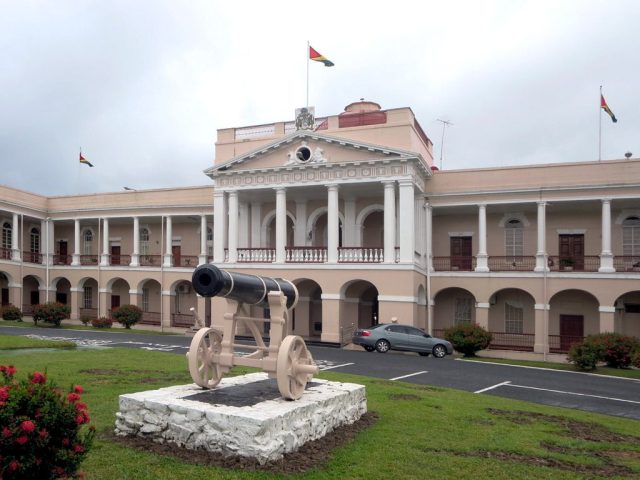
Photo: Dan Sloan, CC BY-SA 2.0
Georgetown doesn’t feel like anywhere else in South America. There are no crowded boulevards packed with tourists, no skyscrapers clawing at the sky. Instead, the streets move at their own pace, lined with overgrown trees and wooden houses whose carved verandas sag slightly with age. The air carries the scent of spices mingling with the salt of the Atlantic, a reminder that this city has always been shaped by the sea.
Founded by the Dutch in the eighteenth century as a small trading post, Georgetown later passed into British hands, and the colonial past lingers in its architecture. Wide avenues shaded by royal palms lead to white wooden churches with steep, pointed roofs, while old merchant houses with lacy balconies hint at the days when sugar and rum made fortunes here. The most striking remnant of that era is St. George’s Cathedral, one of the tallest wooden churches in the world, built without a single nail. Inside, the scent of aged timber and candle wax fills the space, and stained-glass windows cast soft, shifting colors across the floor.
The city sprawls along the Atlantic coast, and water is everywhere—in the canals that cut through the streets, in the fishing boats bobbing at the docks, in the damp air that clings to everything. Local markets overflow with tropical fruit: mangoes, passionfruit, guavas, their sweetness almost overwhelming. The Stabroek Market is a world of its own, where vendors sell everything from handmade crafts to caged parrots, their bright feathers flashing in the sunlight. By evening, when the heat finally eases, people gather along the seawall with cold beers or rum, listening to music as the sun dips below the horizon.
Georgetown isn’t just a capital—it’s the gateway to Guyana’s wild interior. From here, travelers set off toward Kaieteur Falls, where water plunges over two hundred meters into the jungle below, or into the Rupununi savannahs, where jaguars and giant anteaters still roam. The city itself is a mix of cultures, home to descendants of Indigenous peoples, Africans, Indians, Chinese, and Europeans. That diversity shows in the food, the music, even the language. Creole English drifts through the streets, woven with Hindi, Portuguese, and local dialects.
Life in Georgetown moves slowly, but it’s never dull. There are no subways, no traffic jams, no relentless urban rush—just wide verandas where you can sit for hours with a book, watching the rain roll in and out just as quickly. Rain is as much a part of daily life as the heat, which presses down even in the shade. That’s what makes the city feel alive: it doesn’t try to be perfect. It’s just itself—loud, green, a little chaotic, but warm in a way that lingers long after you’ve left.
See & Do
8 places



Places on the map
Marker colour follows the categoryClimate and weather
Detailed weather: Georgetown- Average temperature
- 28 °C
- Precipitation per year
- 2354 mm
- Sunshine hours per day
- 6.5 h
Average air temperature
°C
27
27
28
28
28
28
28
28
29
29
28
27
Jan
Feb
Mar
Apr
May
Jun
Jul
Aug
Sep
Oct
Nov
Dec


