- Home
- North Korea
- Anju
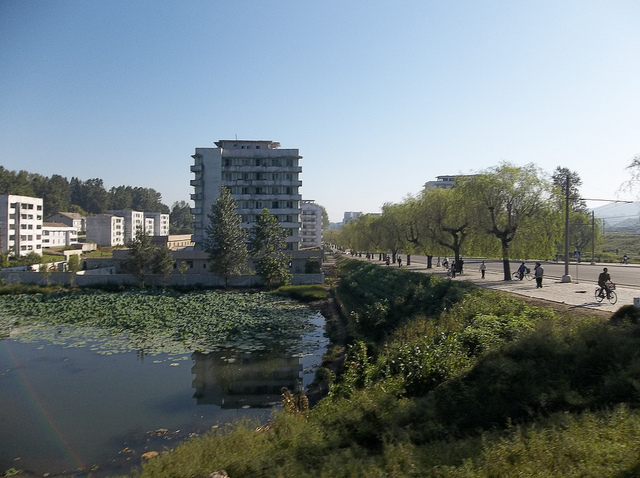
Anju
North Korea · 2 places
Photo: Raymond K. Cunningham, Jr, CC BY-SA 3.0
Anju sits quietly in the northern reaches of the Korean Peninsula. Few travelers come here. The city lies in South Pyongan Province, cradled by the Chongchon River, with low hills and open fields stretching into the distance. There are no wide boulevards or crowds—just the steady rhythm of daily life. Anju isn’t a capital or an industrial powerhouse. It’s a provincial town where time moves differently, revealing details that vanish in bigger cities.
The city’s role as a transport hub
A railway line connects Pyongyang to the northern regions, cutting through Anju. A highway leads toward the Chinese border. Coal mining once drove the local economy, and though the industry has scaled back, its legacy remains. Mines still dot the outskirts. The city is sometimes called North Korea’s "coal capital." Industry doesn’t overshadow life here—it’s part of the fabric.
Buildings and daily life
The architecture is mostly low-rise, built in the functional style of mid-20th-century North Korean cities. The center holds a few administrative buildings and monuments to revolutionary events. They don’t feel imposing. What stands out are the ordinary neighborhoods: markets, benches outside apartment blocks, children playing in courtyards. It’s not like the capital. There’s no polish, just life as it is.
The Chongchon River flows lazily, its banks lined with willows. Low, forested mountains rise in the distance. Locals gather along the waterfront in warmer months, picnicking or sitting quietly. Nearby parks and green spaces draw families. There are no dramatic vistas—just space and stillness.
This isn’t a place for those seeking excitement. There are no high-end hotels or shopping malls. But if you want to see how people live outside Pyongyang, Anju offers a glimpse. It doesn’t try to impress. It just exists. For travelers willing to meet it on its own terms, that might be enough.
Stay
0 placesNothing in this category yet — the catalogue is still growing.
All placesPlaces on the map
Marker colour follows the categoryClimate and weather
Detailed weather: Anju- Average temperature
- 11 °C
- Precipitation per year
- 0 mm
Average air temperature
°C
-5
-2
5
11
16
21
25
25
20
12
5
-4
Jan
Feb
Mar
Apr
May
Jun
Jul
Aug
Sep
Oct
Nov
Dec


